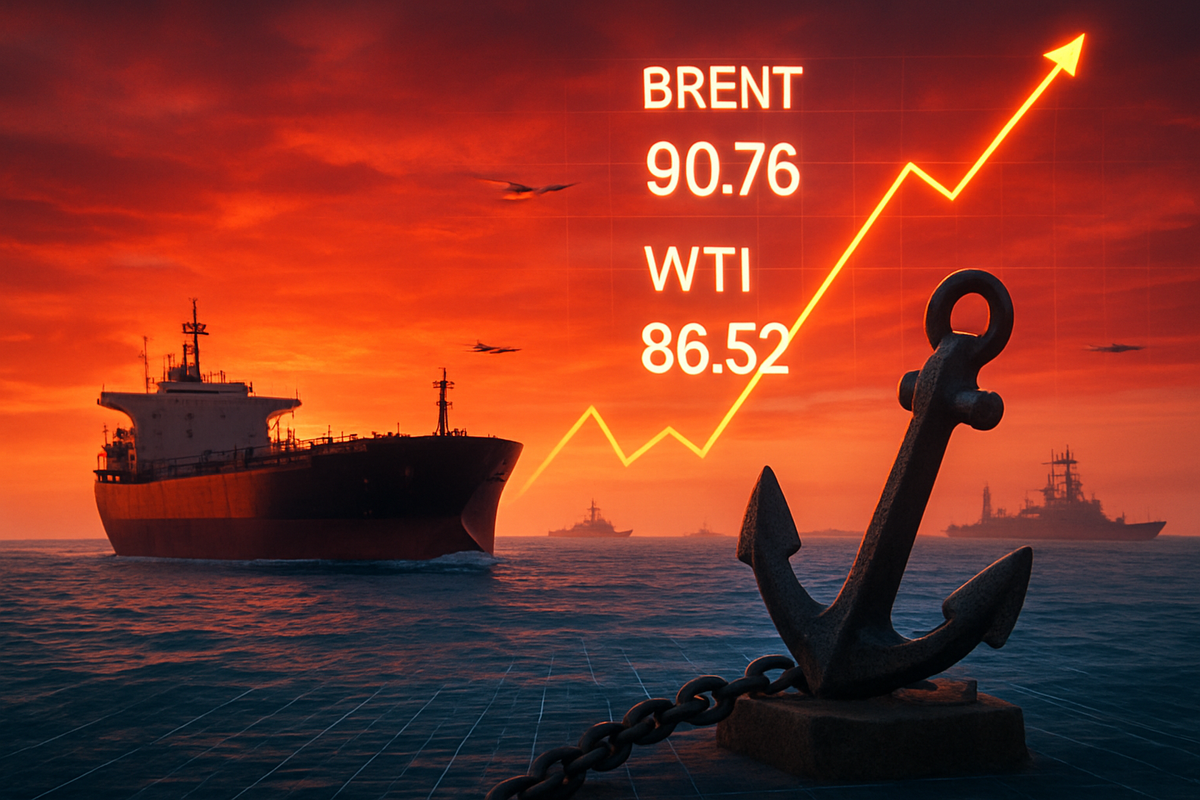
NEW YORK — The ghost of structural inflation has returned to haunt global markets, as a major military escalation in the Middle East has sent energy prices skyrocketing and shattered hopes for imminent interest rate cuts. Following the launch of a significant multi-national military operation in late February, the closure of the Strait of Hormuz has removed nearly 20% of the world’s daily oil supply, forcing investors to price in a "higher for longer" interest rate regime that many had hoped was a relic of the past.
The immediate implications are stark: Brent crude has surged past $110 per barrel, while domestic gasoline prices are climbing toward the $4.50 mark in many U.S. states. On Wednesday, the Federal Reserve maintained its benchmark interest rate at 3.50%–3.75%, but the accompanying "dot plot" and hawkish rhetoric from Chair Jerome Powell suggested that the era of cheap money is not returning anytime soon. With headline inflation projected to hit 4.0% by mid-summer, the market is now grappling with the reality that geopolitical instability has effectively sidelined the "Fed put" for the foreseeable future.
The Escalation of "Operation Epic Fury" and the Hormuz Blockade
The current market turmoil traces back to February 28, 2026, when a joint U.S.-Israeli military campaign, dubbed "Operation Epic Fury," was launched against Iranian military and nuclear infrastructure. The strikes, which targeted over 9,000 sites, led to a rapid and chaotic retaliation from Tehran. By the first week of March, Iran had effectively closed the Strait of Hormuz—the world’s most critical energy chokepoint—using a combination of sea mines and fast-attack watercraft. This blockade has stranded an estimated 10 million barrels of oil per day and massive quantities of Liquefied Natural Gas (LNG), creating a supply-side shock not seen since the 1970s.
Initial market reactions were swift and violent. Brent crude spiked to a peak of $126 per barrel on March 8 before settling into its current volatile range. In the fixed-income markets, the 10-year Treasury yield surged to 4.35%, a level that has acted as a psychological "tripwire" for equity valuations. The Federal Open Market Committee (FOMC) meeting on March 18 confirmed the shift in sentiment; the Fed upwardly revised its 2026 inflation forecasts and signaled that rate hikes—rather than cuts—are back on the table if energy costs continue to bleed into core services inflation.
Winners and Losers: Defense and Energy Surge as Tech Stumbles
The "2026 Energy Shock" has created a stark divide in the S&P 500, with defense contractors and domestic energy producers emerging as the primary beneficiaries. RTX Corporation (NYSE: RTX) has seen its shares hit record highs of $215 this month, driven by a staggering $268 billion backlog as the military moves to replenish missile stockpiles depleted during the conflict. Similarly, Lockheed Martin (NYSE: LMT) has soared 38% year-to-date, with its F-35 program and THAAD missile systems seeing increased international demand.
In the energy sector, ExxonMobil (NYSE: XOM) and Chevron (NYSE: CVX) have become the go-to "safe havens" for investors seeking protection against rising crude prices. Both companies have reported massive cash flow surges, with Chevron trading near $200 per share as of this week. Conversely, the technology sector has faced a "Tech Wreck" due to rising yields. Apple (NASDAQ: AAPL) has seen its stock drop 8% since the start of the year, as high interest rates compress its valuation multiple while high energy costs erode the discretionary income of its customer base. Even AI darling Nvidia (NASDAQ: NVDA) has felt the pinch; despite reporting record revenues, its stock has fallen nearly 20% from its October highs as investors rotate out of high-growth names and into commodity-linked value stocks.
The airline industry is perhaps the hardest hit by the "double whammy" of rising fuel costs and disrupted air corridors. Both Delta Air Lines (NYSE: DAL) and American Airlines (NASDAQ: AAL) have warned of $400 million hits to their quarterly earnings due to jet fuel prices topping $4.00 per gallon. While travel demand remains resilient for now, analysts at Rothschild Redburn have warned that the lack of fuel hedging at major carriers like American Airlines could lead to significant margin erosion if the conflict extends through the peak summer travel season.
Geopolitical Precedents and the Death of the "Transitory" Narrative
This event marks a significant departure from the localized skirmishes of the early 2020s, drawing uncomfortable parallels to the 1973 OPEC oil embargo. In both instances, a geopolitical trigger led to a structural shift in energy prices that Central Banks were slow to contain. The current crisis has forced a broader industry trend toward "energy security" and "reshoring," as Western nations realize the fragility of global supply chains. The U.S. defense budget is now on a trajectory to surpass $1 trillion for the first time in history, signaling a long-term commitment to a high-readiness posture that will likely keep government spending—and thus inflationary pressures—elevated.
The regulatory and policy implications are also mounting. There is renewed pressure on the White House to aggressively refill the Strategic Petroleum Reserve (SPR), which remains at historically low levels, and to fast-track permits for domestic drilling. However, these supply-side solutions take months, if not years, to manifest. In the short term, the Federal Reserve’s "higher for longer" stance is the only tool available to dampen demand, a strategy that risks tipping the global economy into a "stagflationary" period where growth stalls while prices remain stubbornly high.
The Path Forward: Strategic Pivots and Market Scenarios
Looking ahead, the next six months will be critical for both diplomats and fund managers. In the short term, the market is watching for any signs of a "de-escalation" or a breakthrough in reopening the Strait of Hormuz. If the blockade persists through the second quarter, analysts expect Brent crude could test the $150 level, a price point that would almost certainly trigger a global recession. In such a scenario, the market might see a pivot toward "defensive growth" companies with high pricing power and low energy dependency.
Conversely, a "strategic pivot" toward renewable energy infrastructure could accelerate. Companies specializing in nuclear power, solar, and battery storage may find themselves the long-term winners as the "higher for longer" energy cost environment makes the transition to green energy more economically viable. For now, the challenge for investors is navigating the "volatility gap"—the period of high uncertainty before a new equilibrium is reached. Potential scenarios include a "soft landing" if the war ends quickly, or a "hard landing" if the Fed is forced to raise rates to 4.5% or higher to break the back of energy-led inflation.
A Summary of the New Economic Landscape
The events of early 2026 have fundamentally altered the market's trajectory. The transition from a focus on "disinflation" to a fear of "perm-inflation" has been rapid and painful for diversified portfolios. Key takeaways for the coming months include the dominance of the "oil risk premium," the resurgence of value over growth, and the vital importance of geopolitical monitoring for any investor. The market is no longer just watching the Fed; it is watching the Strait of Hormuz.
Moving forward, the primary metric for success will be "resilience." Investors should watch for the monthly PCE and CPI prints, but they must also keep a close eye on the capacity of the U.S. and its allies to secure global energy lanes. The "higher for longer" regime is not just a policy choice by the Fed; it is a structural response to a world that has become significantly more dangerous and expensive. In the coming months, the ability of public companies to pass on these rising costs to consumers will be the ultimate test of their survival in this new era of inflationary anxiety.
This content is intended for informational purposes only and is not financial advice.