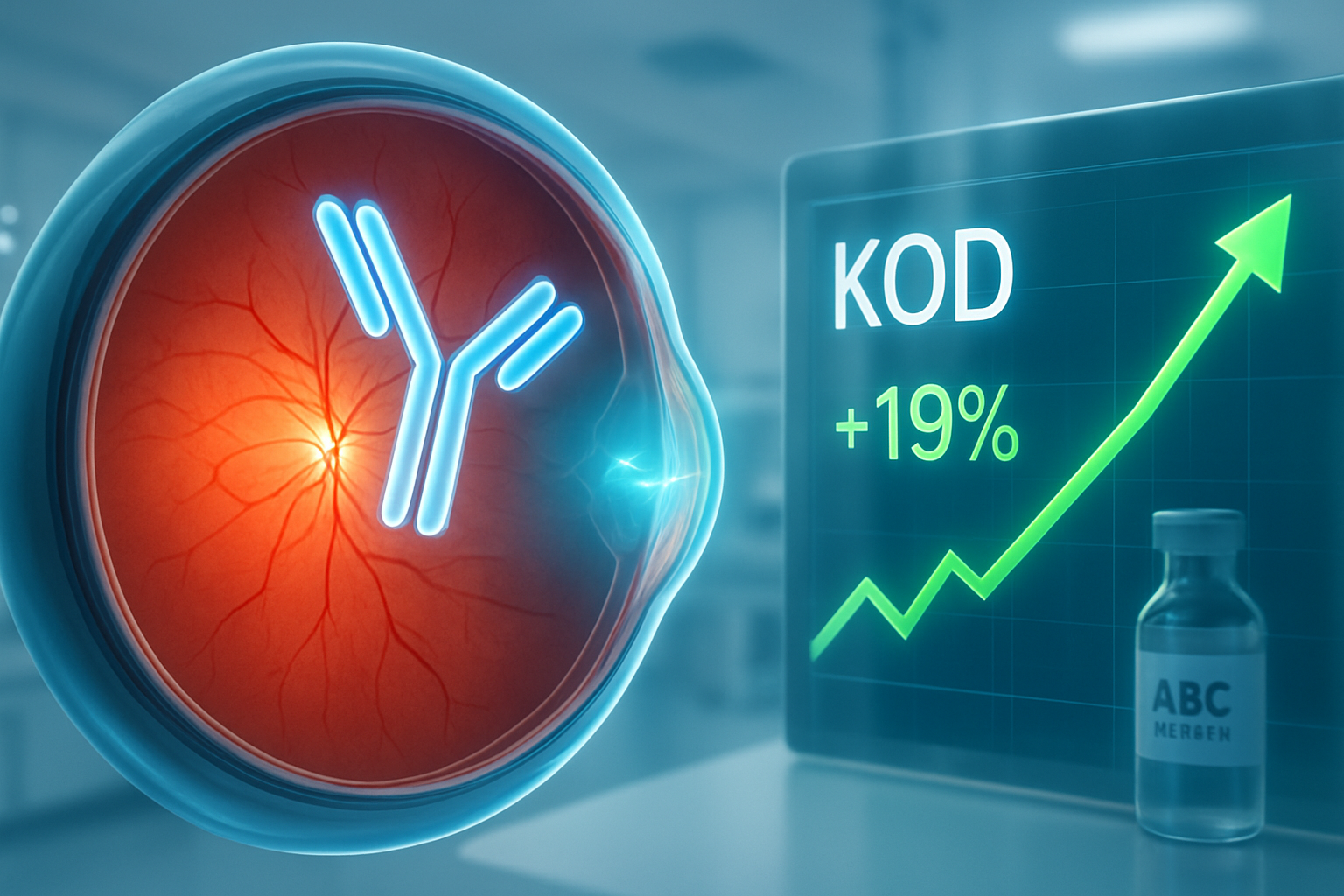
On March 26, 2026, Kodiak Sciences (Nasdaq: KOD) saw its shares ignite, surging 19% in heavy trading following the announcement of overwhelmingly positive topline results from its Phase 3 GLOW2 study. The trial, which evaluated the company's lead product candidate Zenkuda™ (tarcocimab tedromer) in patients with diabetic retinopathy (DR), not only met its primary endpoint with high statistical significance but also demonstrated a safety profile that analysts are calling "best-in-class."
The market's enthusiastic response underscores the high stakes in the multi-billion dollar retinal disease space. By successfully confirming the results of its previous GLOW1 study, Kodiak has cleared a major regulatory hurdle, positioning Zenkuda as a potential disruptor to established therapies. The stock's jump to $22.75 reflects a renewed investor confidence in Kodiak’s Antibody Biopolymer Conjugate (ABC) platform, which had faced skepticism in earlier years but now appears to be delivering on its promise of extended durability and safety.
A Decisive Victory in the GLOW2 Study
The GLOW2 study was a prospective, randomized, double-masked multicenter trial designed to confirm the efficacy and safety of tarcocimab tedromer in treatment-naïve patients with diabetic retinopathy. The data released today showed that 62.5% of patients treated with Zenkuda achieved a ≥2-step improvement in the Diabetic Retinopathy Severity Score (DRSS) at Week 48, compared to a mere 3.3% in the sham-control group. This result was achieved with a p-value of < 0.0001, indicating a highly robust clinical signal.
Beyond the primary endpoint, the study highlighted Zenkuda’s ability to prevent life-altering complications. The drug demonstrated an 85% risk reduction in the development of sight-threatening complications, such as proliferative diabetic retinopathy or diabetic macular edema. Perhaps most importantly for clinicians and patients, the safety data remained pristine. There were zero reported cases of intraocular inflammation (IOI), retinal vasculitis, or occlusive retinal vasculitis—side effects that have historically plagued other long-acting ocular therapies.
The timeline leading to this success has been a journey of redemption for Kodiak. After facing setbacks in 2023 with its wet age-related macular degeneration (wet AMD) trials, the company pivoted to focus on the strength of its diabetic retinopathy data. Today's announcement is the culmination of that strategic shift, validating the "loading dose" flexibility of the ABC platform, which allowed patients in the study to transition to a six-month dosing interval by the end of the first year.
Market reaction was swift and decisive. Trading volume for KOD shares spiked to five times the daily average within the first hour of the market opening. While the stock peaked at a 33% gain in pre-market sessions, it settled into a steady 19% gain as institutional investors balanced the long-term commercialization costs against the massive potential of a Biologics License Application (BLA) submission now slated for late 2026.
Winners and Losers in the Retinal Market
The primary winner of today’s news is undoubtedly Kodiak Sciences (Nasdaq: KOD). The positive data likely secures the company's financial runway and makes it an attractive target for potential acquisition by larger biopharmaceutical firms looking to bolster their ophthalmology pipelines. With the BLA-ready status of tarcocimab for DR, Kodiak is no longer just a "story stock" but a legitimate contender for market share in the $15 billion retinal disease market.
Conversely, established giants like Regeneron (Nasdaq: REGN) may face new headwinds. While Regeneron has successfully migrated many patients to Eylea HD to combat biosimilar entries, Zenkuda’s six-month dosing interval offers a superior durability profile without requiring the surgical intervention associated with Roche (OTC: RHHBY) and its Susvimo implant. If Zenkuda gains approval, it could peel away "new start" patients who prioritize fewer injections and a lower treatment burden.
Roche (OTC: RHHBY) finds itself in a complex position. Its flagship drug Vabysmo remains the current leader in dual-pathway inhibition, but Zenkuda’s simplicity of administration—a standard intravitreal injection rather than a surgical port—could give it an edge in the diabetic retinopathy segment. Furthermore, biosimilar manufacturers like Sandoz (NYSE: SDZ), which are preparing to launch aflibercept biosimilars later this year, may find their total addressable market shrinking if the industry shifts toward longer-acting branded biologics like Zenkuda.
Redefining the Standard of Care
The GLOW2 results fit into a broader industry trend toward "durability," a buzzword in ophthalmology that refers to how long a drug remains effective between injections. For years, the standard of care required injections every four to eight weeks, creating a massive burden for diabetic patients who often have numerous other medical appointments. Zenkuda’s ability to maintain efficacy on a six-month schedule represents a paradigm shift in how chronic eye diseases are managed.
Another significant finding in the GLOW2 data was the sub-analysis of patients using GLP-1 receptor agonists, such as those produced by Novo Nordisk (NYSE: NVO). The study found that Zenkuda’s efficacy was consistent regardless of whether patients were on GLP-1 medications for weight loss or diabetes management. This is a critical piece of data for the 2026 market, where a significant portion of the diabetic population is now using these systemic treatments, which some earlier studies suggested might impact retinopathy progression.
The regulatory implications are also noteworthy. The FDA has recently signaled a lower tolerance for safety signals like intraocular inflammation in long-acting ocular drugs. By delivering a 0% IOI rate in a large Phase 3 trial, Kodiak has set a high bar for safety that may force competitors to rethink their own long-acting delivery platforms. This data likely smoothens the path for a priority review when the BLA is submitted.
The Road Ahead: From Data to Commercialization
Looking forward, the immediate focus for Kodiak will be the completion of its DAYBREAK study in wet AMD, with results expected toward the end of 2026. If DAYBREAK mirrors the success of GLOW2, Kodiak will have a multi-indication blockbuster on its hands. In the short term, the company must begin scaling its manufacturing capabilities and building a commercial infrastructure to support a national launch in 2027.
The strategic pivot required now is a transition from a research-heavy organization to a commercial powerhouse. Kodiak will likely need to engage in strategic partnerships to handle the primary care and optometry referral networks essential for capturing the diabetic retinopathy market. There is also the possibility of a "strategic alternative" where a larger peer acquires Kodiak outright to prevent them from becoming a dominant independent player.
Challenges remain, particularly in the realm of payer negotiations. While a six-month injection is better for the patient, the "cost per dose" will be a point of contention with insurance companies. Kodiak will need to present a compelling pharmacoeconomic case that fewer injections lead to better long-term outcomes and lower overall healthcare costs by preventing blindness and surgeries.
A New Chapter for Kodiak Sciences
Today’s 19% surge in Kodiak Sciences' stock is more than just a reaction to clinical data; it is a validation of a long-term scientific thesis. The GLOW2 study has provided the "gold standard" evidence needed to prove that tarcocimab tedromer can provide high-level efficacy with an unprecedented six-month durability and an exceptional safety profile.
As the market moves forward, investors should keep a close eye on the upcoming DAYBREAK data and any announcements regarding the BLA filing timeline. The retinal disease market is at a crossroads, moving away from frequent, burdensome treatments toward long-acting, highly safe alternatives. Kodiak's performance today suggests it is currently leading that charge.
For the broader market, this event highlights the resilience of biotech innovation. Even after significant setbacks, companies with strong underlying technology and a focus on unmet patient needs can find a path to success. The coming months will determine if Kodiak can successfully navigate the final hurdles of regulatory approval and commercial execution to turn this clinical win into a commercial reality.
This content is intended for informational purposes only and is not financial advice.