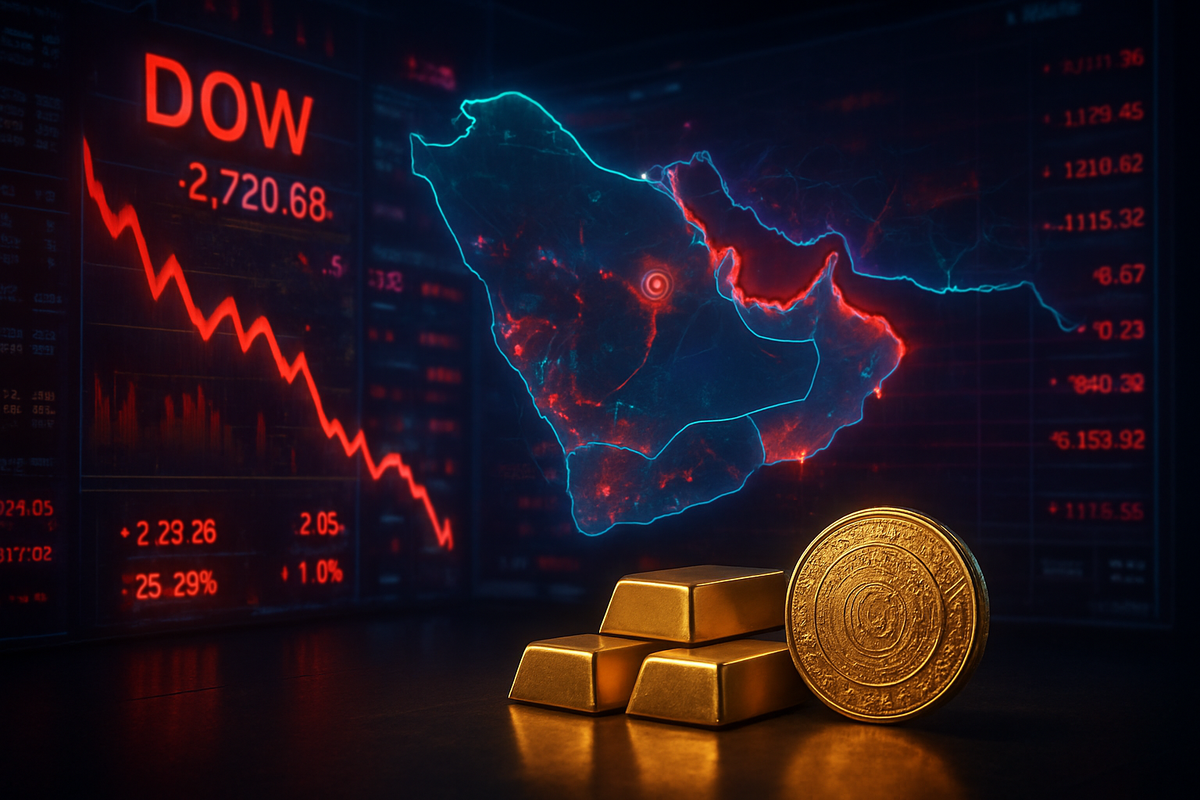
Wall Street woke up to a sea of red this morning, April 2, 2026, as a massive overnight escalation in the Middle East shattered investor confidence and sent shockwaves through global financial systems. A coordinated multi-front strike targeting critical energy infrastructure in the United Arab Emirates and Saudi Arabia has effectively neutralized the region’s "deterrence equilibrium," sparking a violent "risk-off" migration from equities into safe-haven assets like gold and U.S. Treasuries.
By the opening bell in New York, the Dow Jones Industrial Average (INDEXDJX: .DJI) had plunged over 1,100 points, while the tech-heavy Nasdaq (INDEXNASDAQ: .IXIC) saw its steepest opening decline in nearly two years. As the Strait of Hormuz—the world’s most vital oil chokepoint—is declared unnavigable due to naval mines and tactical deployments, the market is now pricing in a "total war" scenario that threatens to reignite inflationary pressures and disrupt the global supply chain once again.
The Night the Equilibrium Collapsed
The relative calm of early spring was violently interrupted at approximately 2:00 AM UTC. Rumors of a ceasefire that had buoyed markets only 24 hours prior were incinerated by an unprecedented swarm of drones and cruise missiles launched against the Port of Fujairah and the Abqaiq oil processing facilities. According to intelligence reports, the strike was a coordinated effort involving Iranian forces and Houthi militants, marking a definitive shift from the proxy skirmishes of 2024 and 2025 to a direct attempt at decapitating regional energy export capacity.
The timeline leading to this morning’s market collapse began with the breakdown of the "Muscat Accords" late last week. When diplomatic channels failed to address renewed maritime blockades in the Bab el-Mandeb, the situation escalated into a full-scale regional crisis. By dawn, the Iranian Navy had officially closed the Strait of Hormuz, effectively trapping 20% of the world’s daily oil supply. The initial reaction on the floor of the New York Stock Exchange was one of visceral panic, as algorithmic trading systems triggered "sell" orders across almost every cyclical sector.
Key stakeholders, including the U.S. State Department and the International Energy Agency (IEA), have already issued emergency warnings. The Federal Reserve, which had been contemplating a series of rate cuts later this summer, is now facing a nightmare scenario: a sudden, massive spike in energy costs that could force a "higher for longer" stance despite a slowing economy. Crude oil prices (NYMEX: CL.1) jumped 14% in pre-market trading, briefly touching $130 per barrel as traders factored in the potential for long-term supply outages.
Defense Surge vs. Tech Retreat
While the broader indices suffered, the defense and energy sectors emerged as the sole beneficiaries of the geopolitical turmoil. Lockheed Martin (NYSE: LMT) saw its stock price surge 7.8% in early trading, as investors anticipate a massive surge in demand for missile defense systems and regional security support. Similarly, RTX Corporation (NYSE: RTX) hit an all-time high of $245, fueled by news of a pending $60 billion emergency defense supplemental bill from the U.S. Congress to replenish interceptor stockpiles like the Patriot and Iron Dome systems.
Palantir Technologies (NYSE: PLTR) also saw a significant boost, climbing 9% as reports surfaced that its AI-driven battlefield intelligence platforms are being utilized by the U.S. Navy to coordinate counter-drone operations in the Gulf of Aden. Conversely, the "Magnificent Seven" and other growth-oriented tech giants are bearing the brunt of the sell-off. NVIDIA Corporation (NASDAQ: NVDA) and Apple Inc. (NASDAQ: AAPL) both tumbled more than 4% at the open, as analysts warned that a secondary "logistics shock" in the Indian Ocean could derail semiconductor and consumer electronics supply chains for the remainder of the year.
The energy sector presented a more complex picture. While ExxonMobil (NYSE: XOM) and Chevron Corporation (NYSE: CVX) initially gained on higher crude prices, those gains were tempered by fears of global demand destruction if the conflict sustains. Integrated oil companies with high exposure to Middle Eastern production are seeing increased volatility, as the physical security of their assets in the Gulf remains in question.
A Return to Geopolitical Volatility
This event marks a significant departure from the localized conflicts of the past decade, fitting into a broader trend of "weaponized interdependence." The deliberate targeting of the Strait of Hormuz suggests that regional actors are now willing to sacrifice global economic stability to achieve strategic goals. This shift mirrors the geopolitical tensions seen during the 1970s oil embargoes, but with the added complexity of modern drone warfare and high-frequency trading.
The ripple effects are likely to be felt far beyond the Middle East. Shipping giants are already rerouting vessels around the Cape of Good Hope, a move that adds significant time and cost to global trade. Furthermore, this escalation complicates the Federal Reserve’s path to a "soft landing." If energy prices remain elevated, the resulting inflationary pressure could prevent the central bank from providing the liquidity the market so desperately craves during times of crisis.
Regulatory and policy implications are also looming. There is renewed pressure on the U.S. government to release more from the Strategic Petroleum Reserve (SPR), though levels remain historically low following the interventions of 2022 and 2024. This leaves the global economy with a dangerously thin margin for error. Historically, markets have shown resilience to geopolitical shocks, but the duration and intensity of this particular escalation suggest that the "buy the dip" mentality may be replaced by a "flight to quality" for the foreseeable future.
Navigating the Fog of War
In the short term, volatility (INDEXCBOE: VIX) is expected to remain near multi-year highs as the market awaits a military or diplomatic response. Strategic pivots are already occurring; fund managers are rotating out of consumer discretionaries and into "hard assets." Gold (COMEX: GC.1) has become the primary beneficiary of this trend, shattering the $5,500 per ounce milestone this morning as it cements its status as the ultimate safe haven in an era of de-globalization and conflict.
Market opportunities may emerge in domestic energy producers and alternative energy sectors if the Middle Eastern blockade persists. However, the immediate challenge for investors is managing the downside risk of a broader economic slowdown. If the "nightmare scenario" of $150 oil becomes a reality by the weekend, the likelihood of a global recession in late 2026 increases dramatically.
Outlook for the Coming Months
The key takeaway for the market on April 2, 2026, is that the era of "cheap energy and safe seas" has faced its greatest challenge yet. The collapse of the deterrence equilibrium in the Middle East has fundamentally altered the risk profile for global equities. Investors should prepare for a period of heightened uncertainty where geopolitical headlines, rather than earnings reports, dictate daily price action.
Moving forward, the market’s trajectory will depend on three factors: the effectiveness of U.S. and allied naval responses in the Strait of Hormuz, the resilience of the global supply chain to another logistics shock, and the Federal Reserve's willingness to look through energy-driven inflation. For now, the "risk-off" tone remains dominant, and the migration to safe havens like gold and defense stocks appears to be just the beginning of a larger structural shift in asset allocation.
This content is intended for informational purposes only and is not financial advice