As of April 7, 2026, the financial markets are witnessing a historic recalibration of the semiconductor sector. Shares of Arm Holdings (Nasdaq: ARM) have surged to a record high of $162.40 this morning, marking a 115% increase over the last 18 months. This rally is underpinned by the company's aggressive expansion into custom AI hardware and the massive adoption of its Neoverse architecture across global data centers, which has effectively challenged the long-standing dominance of traditional x86 computing.
The immediate catalyst for this surge is the overwhelming market response to Arm’s recent transition from a mere designer of blueprints to a provider of production-ready "Compute Subsystems" (CSS) and its own proprietary silicon. With the shift toward "Agentic AI"—autonomous systems that require continuous, high-logic compute—hyperscalers are abandoning off-the-shelf components in favor of Arm’s high-efficiency, tailored designs, driving the company’s royalty rates and total addressable market to unprecedented levels.
The Dawn of Production Silicon: A Strategic Pivot
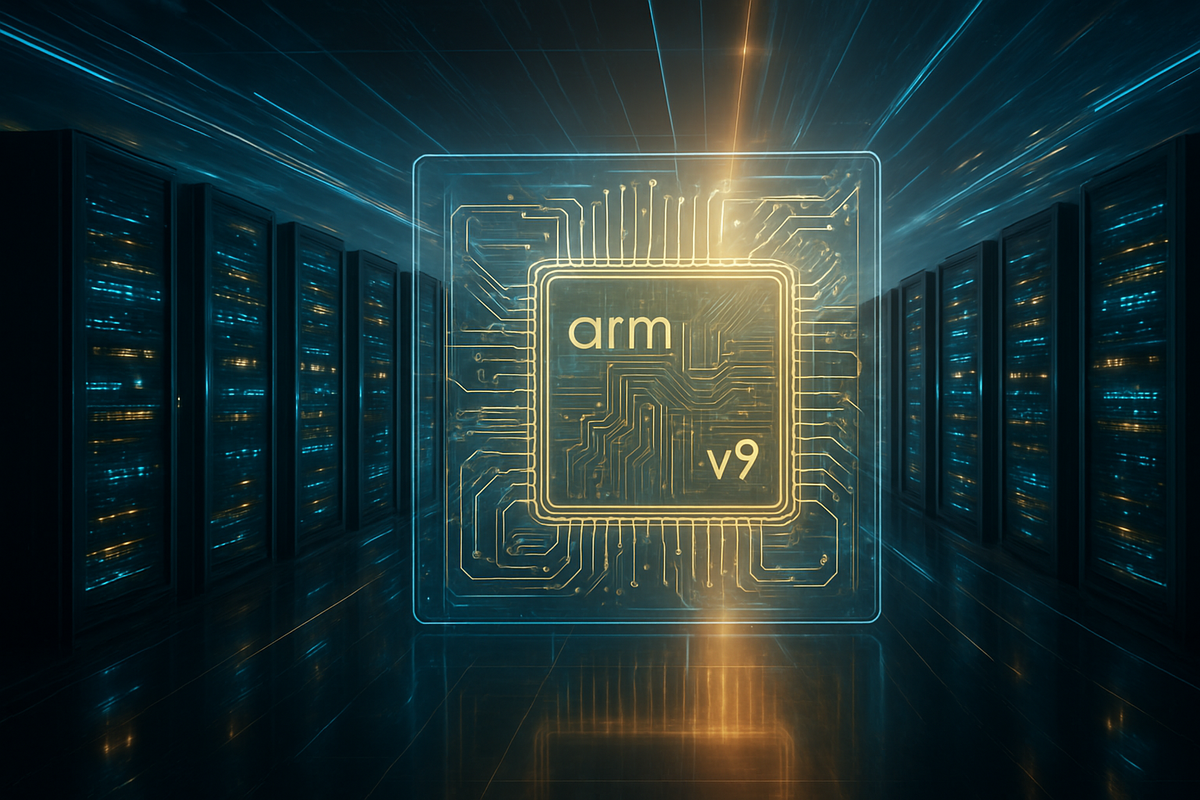
The momentum began building in late 2025 when Arm reported that its v9 architecture was contributing over 50% of its royalty revenue, but the true inflection point occurred in March 2026. Arm officially launched the "AGI CPU," its first proprietary data center processor built on a cutting-edge 3-nanometer process. Featuring 136 Neoverse V3 cores, the AGI CPU is specifically optimized for the "Inference Inflection," where AI models perform real-time reasoning rather than just training. This launch signaled that Arm is no longer content to stay in the background; it is now a direct competitor in the high-performance computing (HPC) space.
This strategic pivot has been years in the making. Since its IPO in late 2023, Arm has steadily shifted its business model to capture more value per chip. By early 2026, the company’s CSS program had secured 21 licenses across 12 major tech firms, allowing cloud giants to bring custom chips to market in half the time it previously took. Market analysts have lauded this "accelerated design" strategy, noting that it has created a recurring revenue flywheel that traditional chipmakers have struggled to replicate.
The initial industry reaction to the AGI CPU was one of shock and rapid reassessment. Major hyperscalers, including Amazon (Nasdaq: AMZN) and Alphabet (Nasdaq: GOOGL), have reportedly integrated these new designs into their next-generation server racks. Industry insiders suggest that the performance-per-watt advantage of Arm’s new silicon could save a single large-scale data center up to $10 billion in capital expenditures over its lifecycle, a value proposition that has made the stock a "must-own" for institutional investors focusing on sustainability and AI infrastructure.
Winners and Losers in the Custom Silicon Arms Race
The primary winner in this structural shift is undoubtedly Arm itself, but the ripples extend to its primary ecosystem partners. Broadcom (Nasdaq: AVGO) continues to thrive as the "master builder" of these custom environments. As the lead architect for bespoke AI accelerators like Google’s TPU v7 and Meta’s (Nasdaq: META) MTIA v4, Broadcom utilizes Arm-compatible architectures for orchestration, driving its own AI-related revenue toward a projected $50 billion in 2026. Similarly, Nvidia (Nasdaq: NVDA) remains a crucial ally; its upcoming "Vera" CPU, scheduled for release in Q3 2026, is built on Arm architecture, ensuring that the most powerful AI "factories" in the world remain firmly rooted in the Arm ecosystem.
However, the rally in Arm shares casts a long shadow over the incumbents of the x86 era. Intel (Nasdaq: INTC) and Advanced Micro Devices (Nasdaq: AMD) are facing a precarious moment as their share of the hyperscale server market has dwindled to roughly 50% as of early 2026—down from over 85% just three years ago. While AMD has successfully pivoted toward its own Instinct AI accelerators, Intel’s struggle to maintain pace with Arm’s power efficiency in the data center has led to a divergence in valuation. Analysts warn that unless these traditional giants can offer a compelling "performance-per-watt" story to match Arm’s 3nm designs, the migration to ARM-based servers may become permanent.
The semiconductor equipment sector is also seeing a split. Companies like ASML (Nasdaq: ASML) and TSMC (Nasdaq: TSM) are clear winners, as the move toward increasingly complex 3nm and 2nm custom chips requires the most advanced lithography and packaging technologies. Conversely, second-tier foundries that lack the capacity for these advanced nodes are being left behind as the industry gravitates toward the high-performance requirements of the Arm-driven AI boom.
Wider Significance: Efficiency as the New Currency
This event represents a fundamental shift in how the technology industry defines "performance." For decades, raw clock speed and transistor count were the primary metrics of success. In the AI-heavy landscape of 2026, however, energy efficiency has become the industry's most valuable currency. With global data center power consumption reaching critical levels, Arm’s ability to deliver superior performance within a strict thermal envelope has made it the de facto standard for the "Sovereign AI" movement—nations and regions building their own local compute clusters to ensure data independence.
The ripple effects are also being felt in the regulatory sphere. As Arm becomes a more dominant player in the data center, its licensing practices are coming under increased scrutiny from global regulators, reminiscent of the antitrust challenges faced by Microsoft (Nasdaq: MSFT) and Intel in previous decades. However, Arm’s open-licensing heritage and its role in enabling "custom" silicon for dozens of different companies may serve as a defense against claims of monopolistic behavior, as it technically fosters a more diverse hardware ecosystem than the old x86 duopoly ever did.
Historically, this transition is comparable to the shift from mainframes to client-server computing in the 1990s. Just as that era minted new giants, the "Custom Silicon Era" of 2026 is redefining the hierarchy of the S&P 500. The move toward vertically integrated hardware—where companies like Apple (Nasdaq: AAPL) and Tesla (Nasdaq: TSLA) design their own chips based on Arm's IP—has proven that the most successful tech companies of the future will be those that control their own silicon destiny.
What Comes Next: The Road to $25 Billion
In the short term, all eyes are on the Q3 2026 release of the Nvidia "Vera" CPU. If Vera performs as expected, it will likely cement Arm’s architecture as the undisputed king of the AI rack. Investors are also watching for the first "Edge AI" results from the upcoming 2026 smartphone cycle, where Arm’s v9.3 architecture is expected to enable true on-device generative AI, potentially sparking a massive consumer hardware refresh.
Long-term, Arm’s management has set an ambitious target of $25 billion in annual revenue by 2031. To reach this, the company will need to successfully navigate its "strategic pivot" from a high-margin IP licensor to a more capital-intensive hardware provider. This transition carries risks, including higher R&D costs and potential friction with its own customers who might see Arm’s AGI CPU as a threat to their own internal chip efforts. The emergence of RISC-V, an open-source competitor to Arm's architecture, also remains a long-term challenge that could gain traction if Arm's licensing fees become too onerous.
Final Assessment: A Pillar of the New Economy
The rally in Arm Holdings is more than just a momentum trade; it is a recognition that the foundational architecture of global computing has changed. By April 2026, Arm has successfully shed its image as a "mobile-only" chip designer and established itself as the indispensable backbone of the AI data center. The company’s move into production silicon marks a bold new chapter that challenges every established player in the semiconductor industry.
For investors, the key takeaway is that the "AI Trade" has evolved from a search for GPUs to a search for the total compute environment. As the software side of AI matures into autonomous agents, the hardware that powers those agents must be more efficient and more integrated than ever before. Arm’s current valuation reflects its status as the unique gatekeeper of this efficiency. While volatility is expected as the company scales its hardware business, its central role in the custom silicon revolution makes it one of the most critical companies to watch through the end of the decade.
This content is intended for informational purposes only and is not financial advice.