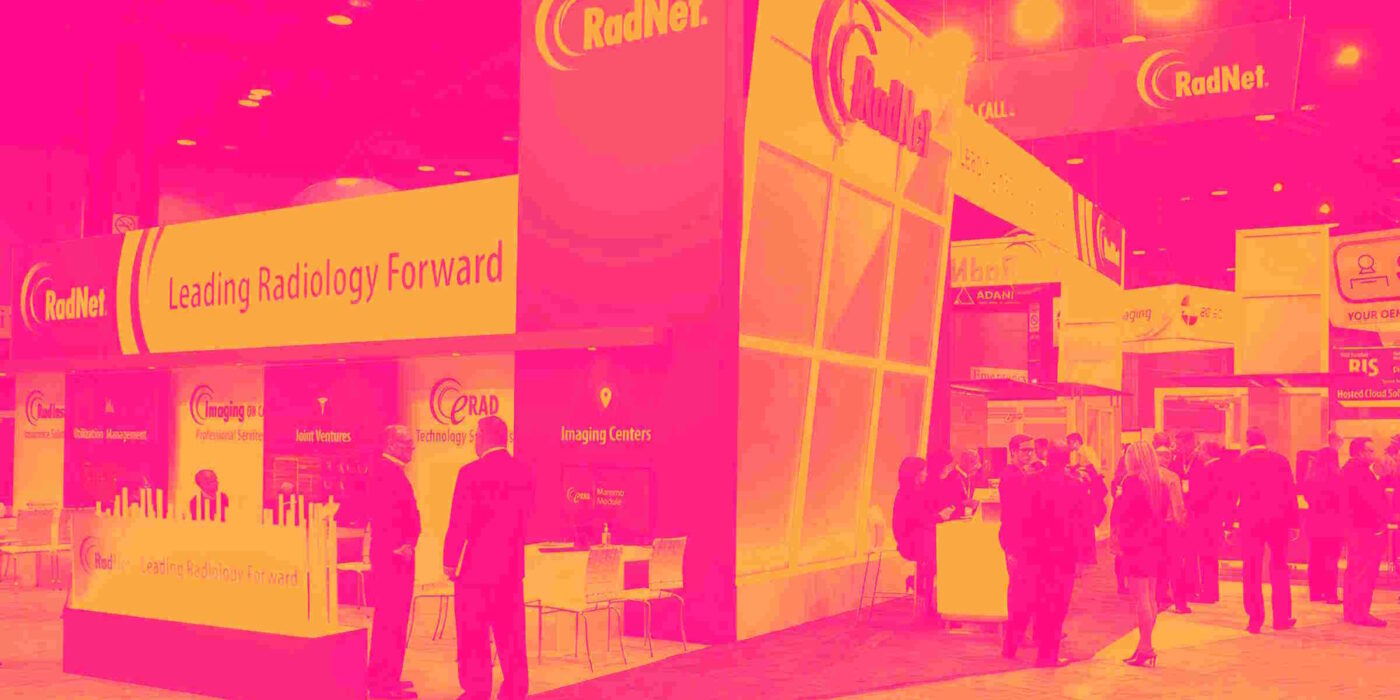
Diagnostic imaging company RadNet (NASDAQ: RDNT) reported Q1 CY2026 results beating Wall Street’s revenue expectations, with sales up 22.1% year on year to $575.6 million. Its non-GAAP loss of $0.28 per share was 46.1% below analysts’ consensus estimates.
Is now the time to buy RDNT? Find out in our full research report (it’s free for active Edge members).
RadNet (RDNT) Q1 CY2026 Highlights:
- Revenue: $575.6 million vs analyst estimates of $558.9 million (22.1% year-on-year growth, 3% beat)
- Adjusted EPS: -$0.28 vs analyst expectations of -$0.19 (46.1% miss)
- Adjusted EBITDA: $63.26 million vs analyst estimates of $59.48 million (11% margin, 6.4% beat)
- Operating Margin: -4.2%, in line with the same quarter last year
- Market Capitalization: $4.38 billion
StockStory’s Take
RadNet’s first quarter was marked by strong revenue growth and a positive market reaction, with management crediting the outperformance to robust demand for advanced imaging and successful integration of new acquisitions. CEO Howard Berger highlighted a notable shift toward higher-margin advanced imaging procedures, supported by investments in updated equipment and the rollout of AI-driven workflow solutions. Management also noted that, despite adverse winter weather impacting results, operational momentum accelerated through March. As Berger stated, “Revenue and adjusted EBITDA were first quarter records despite being negatively impacted by an estimated $13 million of revenue and $9 million of adjusted EBITDA from severe weather conditions.”
Looking ahead, RadNet’s guidance is shaped by continued investment in AI-enabled digital health initiatives, a growing commercial pipeline, and recent expansion into new geographic markets. The company expects these drivers to accelerate both capacity and efficiency, with President Kaes Westorpe emphasizing the transition toward an enterprise-wide AI workflow across imaging modalities. Management remains focused on rolling out new AI solutions and executing on recently acquired joint ventures. As Westorpe explained, "We are on plan to reach our target of more than $140 million in ARR by year end," pointing to both internal deployments and external commercial wins as key contributors.
Key Insights from Management’s Remarks
Management attributed the quarter’s results to growth in advanced imaging, strong integration of acquisitions, and early returns from digital health investments.
-
Advanced Imaging Shift: The business saw a higher proportion of advanced imaging procedures, now at 29.3% of procedural volume, up from 26.9% last year. Management noted that this shift, driven by AI-driven workflow improvements and equipment upgrades, is boosting both throughput and profitability.
-
Digital Health Acceleration: RadNet’s Digital Health segment, anchored by the DeepHealth platform, reported significant momentum, with 95% annual recurring revenue growth year-over-year. Integration of AI tools across mammography, MR, CT, ultrasound, and X-ray is increasing efficiency and expanding addressable market opportunities.
-
Acquisition Integration: The company completed meaningful acquisitions, including Radiology Regional in Florida and Northwest Radiology in Indiana. Management reported these integrations are progressing ahead of schedule, with early operational and financial contributions supporting overall growth.
-
Operational Efficiencies: Deployment of remote scanning (TechLife) and AI-powered reporting tools has reduced exam room closure hours and cut ultrasound slot times by 33%, allowing RadNet to serve more patients without adding physical capacity.
-
Health System Partnerships: The new joint venture with Trinity Health St. Alphonsus in Idaho is seen as a blueprint for scaling RadNet’s AI-enabled operating model with additional health systems, further broadening the company’s national footprint and recurring revenue base.
Drivers of Future Performance
RadNet’s outlook centers on scaling AI adoption, continued integration of acquisitions, and expanding partnerships to drive both revenue and margin improvement.
-
AI Platform Expansion: Management plans to increase the proportion of studies processed through AI, targeting 70% by year-end, which is expected to drive productivity for radiologists and unlock new reimbursement opportunities via procedure-specific billing codes.
-
Acquisition and JV Ramp: Revenue and EBITDA growth are projected to benefit from the full-year impact of recent acquisitions and joint ventures, with a particular focus on rapid deployment of digital health solutions in newly integrated centers and health system partners.
-
Margin Recovery in Digital Health: While recent investments and acquisitions have temporarily reduced Digital Health margins, management anticipates gradual improvement as integration progresses and new products gain scale, with the core organic business already operating at higher profitability levels.
Catalysts in Upcoming Quarters
In upcoming quarters, the StockStory team will focus on (1) execution and ramp-up of AI-powered workflow solutions across both legacy and newly acquired centers, (2) the pace of integration and performance of recent acquisitions and joint ventures, and (3) progress in scaling health system partnerships that leverage the DeepHealth platform. Regulatory updates affecting imaging reimbursement and the commercial impact of new FDA-cleared AI products will also be important markers.
RadNet currently trades at $55.93, down from $58.19 just before the earnings. In the wake of this quarter, is it a buy or sell? See for yourself in our full research report (it’s free).
Our Favorite Stocks Right Now
ONE MORE THING: Top 6 Stocks for This Week. This market is separating quality stocks from expensive ones fast. AI taking down whole sectors with no warning. In a rotation this fast, you need more than a list of good companies.
Our AI system flagged Palantir before it ran 1,662%. AppLovin before it ran 753%. Nvidia before it ran 1,178%. Each week it produces 6 new names that pass the same tests. Get Our Top 6 Stocks for Free HERE.
Stocks that have made our list include now familiar names such as Nvidia (+1,326% between June 2020 and June 2025) as well as under-the-radar businesses like the once-micro-cap company Kadant (+351% five-year return). Find your next big winner with StockStory today.