The end of an earnings season can be a great time to discover new stocks and assess how companies are handling the current business environment. Let’s take a look at how Halozyme Therapeutics (NASDAQ: HALO) and the rest of the therapeutics stocks fared in Q1.
Over the next few years, therapeutic companies, which develop a wide variety of treatments for diseases and disorders, face strong tailwinds from advancements in precision medicine (including the use of AI to improve hit rates) and growing demand for treatments targeting rare diseases. However, headwinds such as rising scrutiny over drug pricing, regulatory unknowns, and competition from larger, more resourced pharmaceutical companies could weigh on growth.
The 11 therapeutics stocks we track reported a satisfactory Q1. As a group, revenues beat analysts’ consensus estimates by 15.6%.
In light of this news, share prices of the companies have held steady as they are up 3.2% on average since the latest earnings results.
Halozyme Therapeutics (NASDAQ: HALO)
Known for transforming hours-long intravenous infusions into minutes-long subcutaneous injections, Halozyme Therapeutics (NASDAQ: HALO) develops and licenses its proprietary ENHANZE technology that enables subcutaneous delivery of injectable drugs that would otherwise require intravenous administration.
Halozyme Therapeutics reported revenues of $376.7 million, up 42.2% year on year. This print exceeded analysts’ expectations by 6.1%. Overall, it was a satisfactory quarter for the company with a solid beat of analysts’ revenue estimates but a slight miss of analysts’ full-year EPS guidance estimates.
"I am pleased to announce our new $1 billion share repurchase program and that we project to repurchase at least $400 million in 2026, which is a reflection of our strong cash generation and confidence in the long-term value and durability of our business. We started 2026 with exceptional momentum, highlighted by three new recent collaboration and licensing agreements with Vertex, Oruka and GSK, demonstrating the strong interest in Hypercon and ENHANZE and showcasing the real potential to exceed our goal of three new SC delivery platform deals this year. The two Hypercon multi-target agreements confirm the strong interest of biopharma companies to reduce injection volume through hyperconcentration and allow more flexible administration in the home. Our new multi-target agreement with GSK represents a significant opportunity for ENHANZE with multiple promising oncology targets, including its first potential application with antibody drug conjugates. This momentum creates durable new royalty opportunity beginning in the 2030s and extending to at least the mid-2040s," said Dr. Helen Torley, President and Chief Executive Officer of Halozyme.
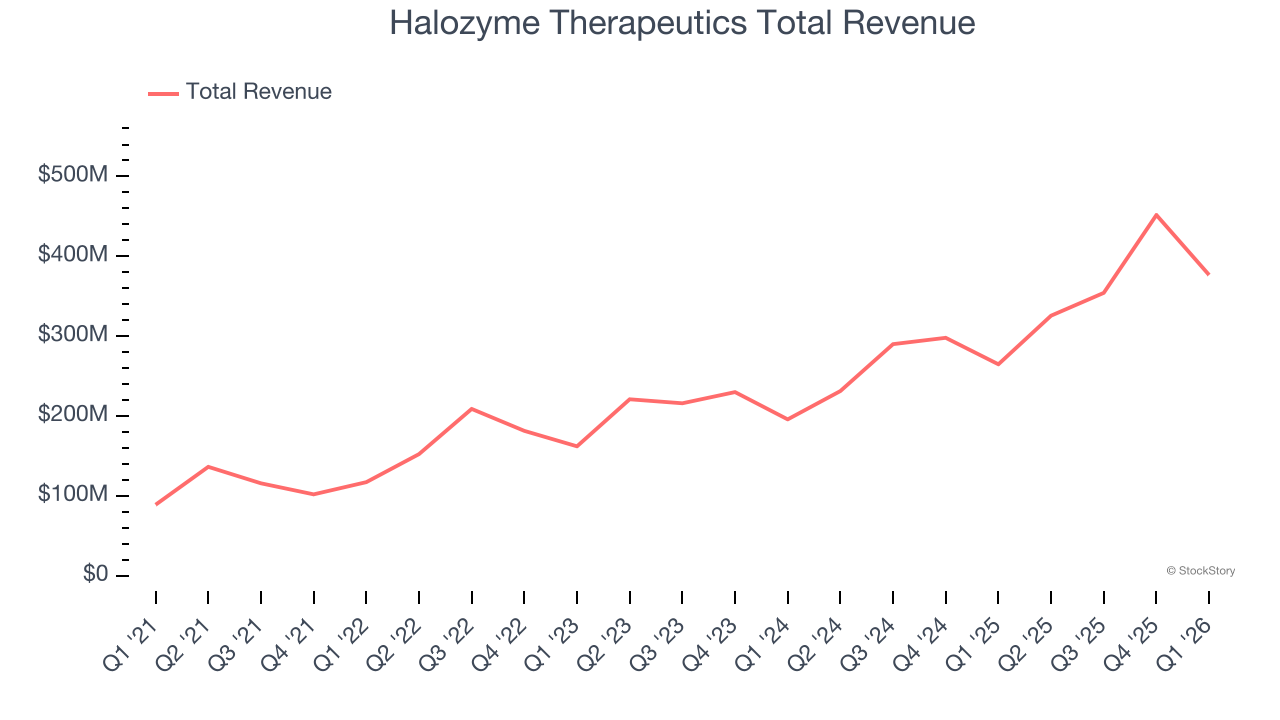
Halozyme Therapeutics delivered the weakest full-year guidance update of the whole group. Interestingly, the stock is up 8.3% since reporting and currently trades at $71.92.
Is now the time to buy Halozyme Therapeutics? Access our full analysis of the earnings results here, it’s free.
Best Q1: Moderna (NASDAQ: MRNA)
Rising to global prominence during the COVID-19 pandemic with one of the first effective vaccines, Moderna (NASDAQ: MRNA) develops messenger RNA (mRNA) medicines that direct the body's cells to produce proteins with therapeutic or preventive benefits for various diseases.
Moderna reported revenues of $389 million, up 260% year on year, outperforming analysts’ expectations by 55.8%. The business had an incredible quarter with a beat of analysts’ EPS and revenue estimates.
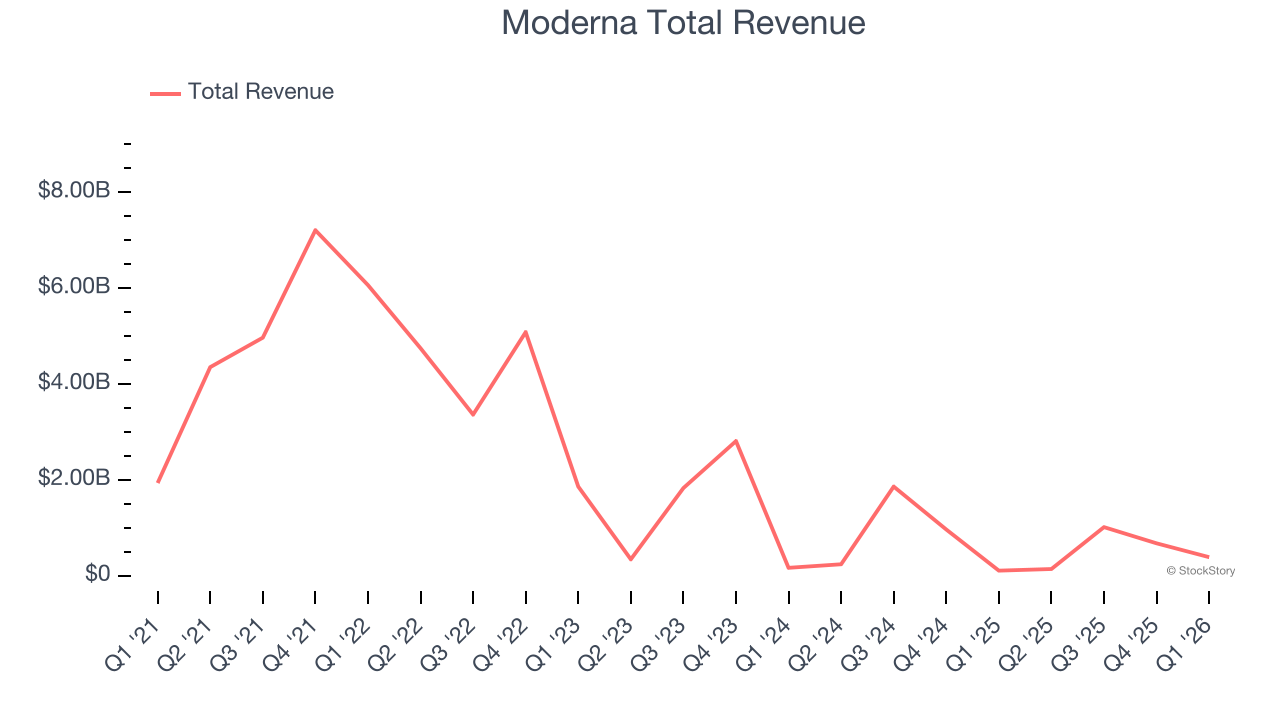
Moderna pulled off the fastest revenue growth among its peers. The market seems happy with the results as the stock is up 16% since reporting. It currently trades at $53.31.
Is now the time to buy Moderna? Access our full analysis of the earnings results here, it’s free.
Weakest Q1: United Therapeutics (NASDAQ: UTHR)
Founded by a mother seeking treatment for her daughter's pulmonary arterial hypertension, United Therapeutics (NASDAQ: UTHR) develops and commercializes medications for chronic lung diseases and other life-threatening conditions, with a focus on pulmonary hypertension treatments.
United Therapeutics reported revenues of $781.5 million, down 1.6% year on year, falling short of analysts’ expectations by 1.9%. It was a disappointing quarter as it posted a significant miss of analysts’ EPS and revenue estimates.
United Therapeutics delivered the weakest performance against analyst estimates in the group. The stock is flat since the results and currently trades at $569.00.
Read our full analysis of United Therapeutics’s results here.
BioMarin Pharmaceutical (NASDAQ: BMRN)
Pioneering treatments for conditions that often had no previous therapeutic options, BioMarin Pharmaceutical (NASDAQ: BMRN) develops and commercializes therapies that address the root causes of rare genetic disorders, particularly those affecting children.
BioMarin Pharmaceutical reported revenues of $766.2 million, up 2.8% year on year. This number missed analysts’ expectations by 1.3%. Zooming out, it was a mixed quarter as it also recorded an impressive beat of analysts’ full-year EPS guidance estimates but a significant miss of analysts’ EPS estimates.
The stock is down 5.2% since reporting and currently trades at $52.58.
Read our full, actionable report on BioMarin Pharmaceutical here, it’s free.
Amgen (NASDAQ: AMGN)
Founded in 1980 during the early days of the biotechnology revolution, Amgen (NASDAQ: AMGN) is a biotechnology company that discovers, develops, and manufactures innovative medicines to treat serious illnesses like cancer, osteoporosis, and autoimmune diseases.
Amgen reported revenues of $8.62 billion, up 5.8% year on year. This result surpassed analysts’ expectations by 1.4%. More broadly, it was a satisfactory quarter as it also produced a beat of analysts’ EPS estimates but full-year revenue guidance meeting analysts’ expectations.
The stock is down 2.7% since reporting and currently trades at $337.04.
Read our full, actionable report on Amgen here, it’s free.
Market Update
Late in 2025 into early 2026, there was hand wringing around artificial intelligence. For software companies, the fear was that AI would erode pricing power and compress margins as new tools made it easier to replicate what once required expensive enterprise platforms. Crypto investors had their own version of the same anxiety: if AI agents could trade, allocate capital, and manage wallets autonomously, what exactly was the long-term value of today’s crypto infrastructure?
These concerns triggered a noticeable rotation away from these sectors and into safer havens. But markets rarely dwell on one narrative for long. Spring 2026 came, and the focus shifted abruptly from technological disruption to geopolitical risk. The US’ conflict with Iran became the dominant driver of market psychology, and when geopolitics takes center stage, the script changes quickly. Investors stop debating growth rates and start worrying about oil supply, inflation, and global stability.
Want to invest in winners with rock-solid fundamentals? Check out our Strong Momentum Stocks and add them to your watchlist. These companies are poised for growth regardless of the political or macroeconomic climate.
StockStory’s analyst team — all seasoned professional investors — uses quantitative analysis and automation to deliver market-beating insights faster and with higher quality.