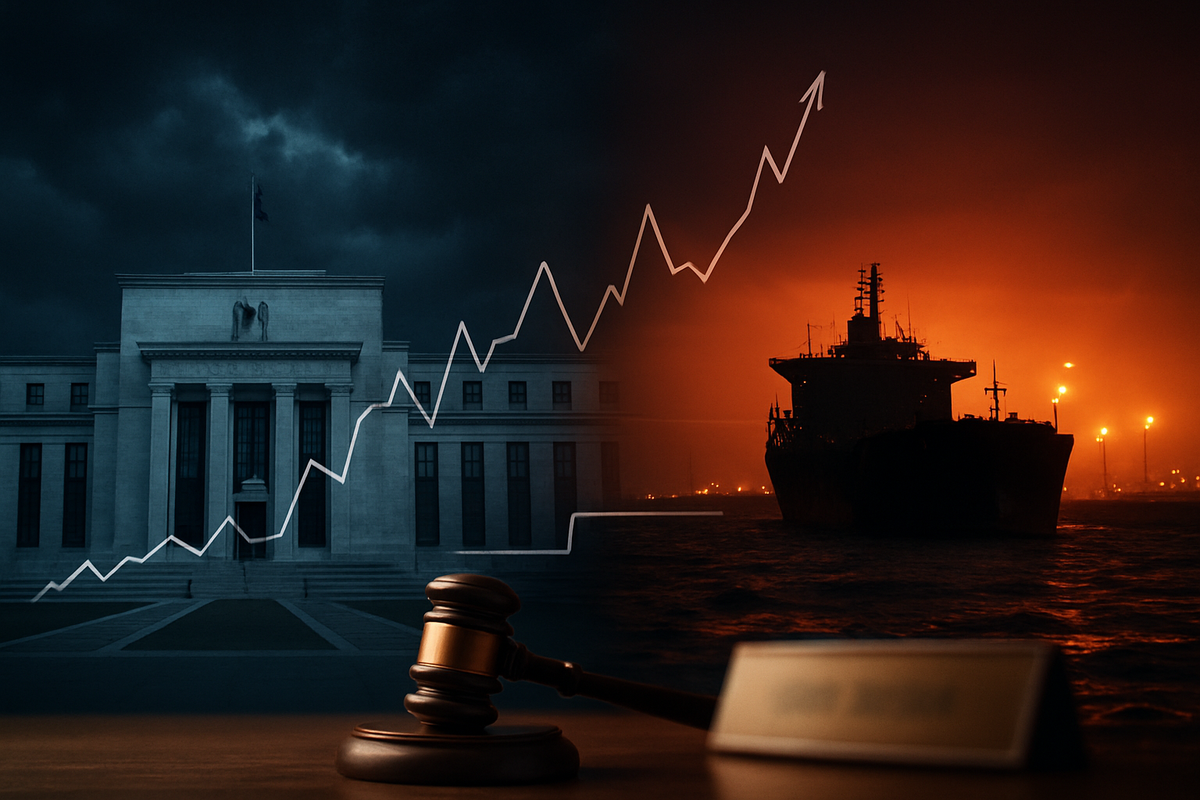
As the sun begins to set on Jerome Powell’s tenure as Chair of the Federal Reserve this May, the global financial landscape has been upended by a "perfect storm" of geopolitical volatility and resurgent inflation. What was once expected to be a victory lap for the central bank—marked by a series of rate cuts to solidify a soft landing—has instead transformed into a high-stakes recalibration. Driven by an oil-driven inflation shock stemming from the escalating conflict with Iran, market participants are rapidly abandoning hopes for a pivot toward easing, bracing instead for a "higher-for-longer" reality that could define the next era of American monetary policy.
The sudden shift in sentiment has been nothing short of dramatic. Just three months ago, the consensus among economists and traders was for at least two, and possibly three, interest rate cuts in 2026. However, as of April 2, 2026, the CME FedWatch Tool and Polymarket now show a staggering 98% probability that the Fed will hold rates steady at its upcoming April 28–29 meeting. With PCE inflation projected to climb back toward 3.5% in the wake of $100-per-barrel oil, the narrative of "disinflation" has been replaced by the specter of stagflation, leaving the incoming Fed leadership with little room for error.
The Stalled Torch: Warsh, Powell, and Operation Epic Fury
The leadership transition at the Federal Reserve is currently caught in a vice between administrative ambition and legislative gridlock. On January 30, 2026, the White House formally nominated Kevin Warsh to succeed Jerome Powell. Warsh, a former Fed Governor with a reputation as a monetary hawk, was initially seen as a choice to satisfy both productivity-minded technocrats and those seeking a shift from the Powell era. However, the confirmation process in the Senate has ground to a halt. Led by Senator Thom Tillis, a faction of lawmakers has refused to move the nomination forward until the Department of Justice concludes its investigation into a $2.5 billion renovation of the Fed’s headquarters—a probe that has cast a shadow over Powell’s final weeks in office.
While the political drama unfolds in Washington, the catalyst for the market's recalibration lies thousands of miles away. On February 28, 2026, the geopolitical landscape fractured following "Operation Epic Fury," a series of devastating airstrikes by U.S. and Israeli forces against Iranian military and nuclear sites. The strikes, which reportedly resulted in the death of Supreme Leader Ali Khamenei, triggered an immediate and aggressive retaliation. On March 4, Iran’s Revolutionary Guard moved to effectively close the Strait of Hormuz, the world’s most vital energy artery.
The impact was instantaneous. Brent crude oil, which had been trading in the mid-$70s, surged past the $100 mark in a matter of days. With nearly 20% of the world’s daily oil supply now held hostage by the naval blockade, analysts at Goldman Sachs (NYSE: GS) and Oxford Economics have warned that prices could reach as high as $190 per barrel if a diplomatic resolution is not reached by mid-summer. This energy "tax" on the global consumer has effectively paralyzed the Fed’s plans to lower the benchmark interest rate from its current range of 3.50%–3.75%.
Energy Giants Surge as Transporters Reel Under Fuel Pressure
The diverging fortunes of public companies have become the primary focus for Wall Street as the "Iran Shock" ripples through the S&P 500. Unsurprisingly, the energy sector has emerged as the primary beneficiary of the supply crunch. Giants like Exxon Mobil Corp (NYSE: XOM) and Chevron Corp (NYSE: CVX) have seen their stock prices climb as they leverage higher realized prices for crude. Similarly, defense contractors such as Lockheed Martin (NYSE: LMT) and RTX Corp (NYSE: RTX) have seen a surge in order backlogs as the conflict in the Middle East necessitates a replenishment of precision munitions and missile defense systems.
Conversely, the "losers" of this environment are found in sectors where energy is a primary input cost. The airline industry, already struggling with labor costs, has been dealt a staggering blow. Delta Air Lines (NYSE: DAL) and United Airlines Holdings (NASDAQ: UAL) have seen their shares retreat as the price of jet fuel mirrors the spike in crude. Consumer-facing giants like Amazon.com Inc (NASDAQ: AMZN) are also under pressure, as the cost of last-mile delivery and global logistics threatens to eat into margins that were already being squeezed by cooling consumer demand.
Financial institutions like JPMorgan Chase & Co (NYSE: JPM) find themselves in a complex position. While higher-for-longer interest rates generally support net interest margins, the heightened risk of a recession—triggered by the oil shock—increases the likelihood of credit losses. The broader market volatility has also dampened investment banking activity, as the uncertainty surrounding the Fed's next move has led many corporations to delay debt issuance and M&A activity.
A Return to the 1970s? Assessing the Global Ripple Effects
The current situation bears a haunting resemblance to the oil shocks of 1973 and 1979, periods that fundamentally reshaped global economics. The "synchronized global downturn" that economists now fear is not just an American phenomenon; energy-dependent economies in Europe and East Asia are even more vulnerable to the closure of the Strait of Hormuz. For the Federal Reserve, the dilemma is a classic "Volcker moment." If the central bank cuts rates to support growth, it risks letting inflation spiral out of control. If it keeps rates high to fight oil-driven inflation, it could accelerate a deep recession.
This event fits into a broader trend of "geopolitical risk" becoming the primary driver of market valuations, overshadowing traditional corporate earnings. The shift from a world of globalized, cheap energy to one of fractured supply chains and localized conflict is forcing a permanent re-rating of risk. Furthermore, the regulatory environment is likely to shift, with renewed pressure on the U.S. government to expand domestic drilling and fast-track LNG export facilities to mitigate the influence of Middle Eastern volatility.
Historical precedents suggest that energy-driven inflation is notoriously difficult to "extinguish" with monetary policy alone. Unlike the post-pandemic inflation, which was fueled by stimulus and supply chain snags, the 2026 shock is rooted in physical scarcity and hot war. This makes the upcoming transition from Powell to Warsh particularly perilous, as any perceived misstep by a "new" Fed Chair could lead to a loss of market confidence in the dollar's purchasing power.
The Road to May: Strategic Pivots and Worst-Case Scenarios
Looking ahead to the May transition, the central question is whether Kevin Warsh will be forced to pivot from his hawkish roots to provide liquidity to a freezing market, or if he will double down on inflation fighting. In the short term, investors should expect extreme volatility in the bond market. If the Strait of Hormuz remains closed, the "zero cut" scenario for 2026 will likely become the base case, with some outlier analysts even suggesting that a rate hike could be back on the table by year-end.
Strategic adaptations are already underway. Multi-national corporations are increasingly looking to "on-shore" production to reduce exposure to international shipping lanes, a move that may protect them from future shocks but will inevitably raise the baseline cost of goods. For the Federal Reserve, the next six months will be a test of institutional resilience. If the nomination of Warsh remains stalled, the Fed may be forced to operate under an interim leader during the greatest geopolitical crisis of the decade—a scenario that would likely trigger further panic in the equity markets.
The emergence of a "bipolar" market is the most likely long-term outcome. One side will consist of "hard asset" companies—energy, mining, and defense—that thrive on scarcity and conflict. The other will consist of "efficiency" plays—AI-driven technology and automation—that seek to lower costs in a high-inflation world. Investors who can successfully navigate between these two poles will likely outperform in the turbulent years ahead.
Conclusion: A New Era of Uncertainty
The leadership transition at the Federal Reserve was intended to be a moment of continuity and stabilization. Instead, it has become the epicenter of a global economic crisis. The combination of "Operation Epic Fury," the subsequent oil shock, and the legislative gridlock surrounding Kevin Warsh's nomination has fundamentally altered the path of interest rates. The market's move from expecting two cuts to potentially zero is a stark admission that the "inflation monster" has not been fully tamed, but merely transformed.
As Jerome Powell prepares to step down, his legacy will be inextricably linked to how he manages these final, chaotic months. For investors, the key takeaways are clear: the era of cheap money is firmly in the rearview mirror, and geopolitical risk is now a permanent fixture of the balance sheet. Moving forward, the market will be hyper-sensitive to any updates regarding the Strait of Hormuz and the Senate's progress on the Fed Chair confirmation. The months ahead will require a defensive posture, a focus on energy security, and a watchful eye on the 3.5% inflation threshold that now serves as the Fed's "line in the sand."
This content is intended for informational purposes only and is not financial advice.